Harvester ants and native fire ants thrive in the compacted native caliche and gravel yards common throughout Ahwatukee Foothills, Desert Ridge, and Norterra. Unlike invasive imported red fire ants, desert fire ants…
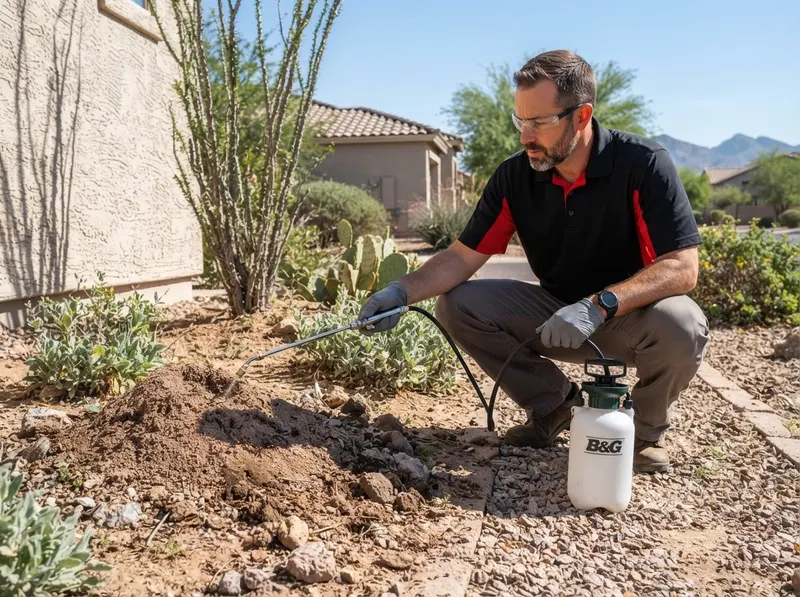
Harvester ants and native fire ants thrive in the compacted native caliche and gravel yards common throughout Ahwatukee Foothills, Desert Ridge, and Norterra. Unlike invasive imported red fire ants, desert fire ants nest under decorative river rock, utility boxes, and pavers around residential foundations. Harvester ants establish extensive sub-surface networks characterized by flat, cleared circular clearings 3 to 10 feet wide, frequently stripping turfgrass and citrus roots in Arcadia, North Central Phoenix, and Biltmore Area properties. Surface-level repellent retail sprays fail against these species because contact toxins kill only 5% to 10% of surface foragers, prompting desert subterranean colonies to split via budding into multiple satellite nests within exterior block walls.
Halvoro Pest Patrol resolves desert ant infestations through active Integrated Pest Management (IPM) protocols regulated by the Pest Management Division of the Arizona Department of Agriculture. The procedure begins with a soil moisture and food-preference evaluation, mapping distinct subterranean foraging trails running along hardscape edging. For harvester ants, custom seed-based attractants carrying micro-dosed metabolic inhibitors are broadcast across clearings, enabling workers to transport the active ingredient directly into deeper brood chambers 6 to 12 feet below the surface. Desert fire ant colonies are neutralized with high-protein lipid baits and targeted non-repellent liquid saturations applied straight to the core nest, eliminating the reproductive queen without triggering outward dispersal into living spaces.
Property owners choose specialized perimeter baiting when outdoor play areas, dog runs, and irrigation zones in Maryvale, Willo Historic District, or Alhambra experience ongoing stings and stripped landscaping. While broad-spectrum liquid applications offer temporary knockdowns of surface foragers within 24 hours, slow-acting biological baits require 7 to 14 days to fully extinguish subterranean brood networks. The resulting trade-off favors structural persistence: deep-colony elimination prevents long-term foundation undermining, whereas uncalibrated liquid spraying merely pushes active foragers toward stucco expansion joints and patio door thresholds. Halvoro Pest Patrol avoids long-term contract lock-ins, delivering direct desert species suppression verified during initial evaluation.
Every job gets a firm, written price after a free on-site visit.
Tell us about your desert fire ant and harvester ant management job in Phoenix and we'll send a clear, written quote, usually the same day.
 Halvoro Pest Patrol