Subterranean termite soil drench and injection establishes an unbroken chemical barrier around building foundations, stopping subterranean termites (Heterotermes aureus) native to the Sonoran Desert. Desert…
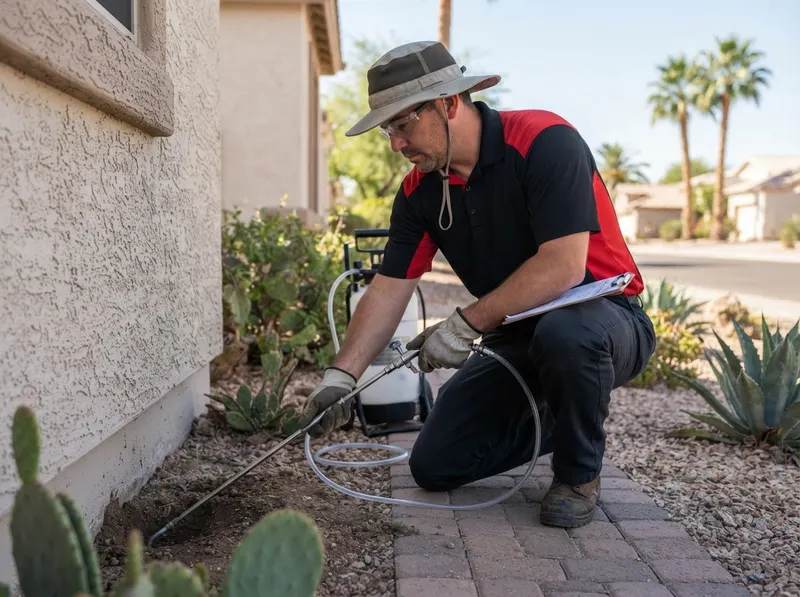
Subterranean termite soil drench and injection establishes an unbroken chemical barrier around building foundations, stopping subterranean termites (Heterotermes aureus) native to the Sonoran Desert. Desert subterranean termites inhabit soil layers up to 10 feet deep to escape surface soil temperatures exceeding 140 degrees Fahrenheit during Phoenix summers. When monsoons arrive, these colonies migrate upward through caliche ground structures, constructing mud tubes over post-tension concrete slabs. Halvoro Pest Patrol trenches soil along exterior perimeter stem walls at a standard depth of 6 inches and a width of 6 inches, applying finished termiticide emulsion at a label rate of 4 gallons per 10 linear feet. Where patios, driveways, or garage slabs abut structural footings, technicians drill vertical 1/2-inch access holes spaced every 10 to 12 inches to inject the barrier directly into subterranean moisture zones beneath the concrete.
Decision guidance depends on foundation design, exterior paving footprint, and localized structural risks. A perimeter soil drench and sub-slab injection suits properties with active shelter tubes, expansive soil contact, or structural framing close to grade levels, such as historic homes in the Willo Historic District or mid-century ranch slabs in North Central Phoenix. The alternative, perimeter bait stations installed every 10 to 20 feet, fits zero-lot-line properties or situations where perimeter concrete drilling is prohibited by structural covenants; however, baiting systems require ongoing multi-month monitoring before colony elimination occurs. A liquid barrier treatment delivers immediate defensive exclusion at the foundation line, though it requires permanent drilling through decorative surfaces like flagstone or aggregate concrete bordering homes in Arcadia and the Biltmore Area.
Soil composition across Maricopa County influences treatment integrity and chemical dispersion. In northern foothill neighborhoods like Desert Ridge, Norterra, and Ahwatukee Foothills, hard caliche deposits restrict vertical fluid migration, requiring specialized mechanical sub-slab pressure rods operating at 25 to 30 PSI to ensure complete saturating penetration. Conversely, fine sandy loam across Maryvale and Alhambra absorbs liquid termiticide quickly, demanding precise flow-meter monitoring to prevent chemical dissipation below the primary 2-to-4-foot root line. Halvoro Pest Patrol delivers targeted Sonoran defense with zero contract traps, verifying all trench depths, slab drill holes, and liquid volumes in compliance with rules set by the Pest Management Division of the Arizona Department of Agriculture.
Every job gets a firm, written price after a free on-site visit.
Tell us about your subterranean termite soil drench and injection job in Phoenix and we'll send a clear, written quote, usually the same day.
 Halvoro Pest Patrol